When Perfect Previews Kill the Best Ideas: The Case Against Finishing Too Early
There's a moment in almost every production design conversation where someone pulls up a render so slick, so detailed, so thoroughly done-looking that the room goes quiet. Not in awe, exactly. More like the kind of quiet that happens when everyone senses the decision has already been made — even though no one officially made it.
That's the trap.
We've gotten extraordinarily good at making things look finished before they are. The tools are incredible. Real-time rendering engines, AI-assisted lighting, photorealistic material libraries — a single designer with a capable workstation can now generate visuals that would've required an entire VFX team a decade ago. And none of that is bad, in isolation. The problem is what happens to the creative process when those capabilities get deployed too early, too confidently, and too often.
The Render as Argument-Ender
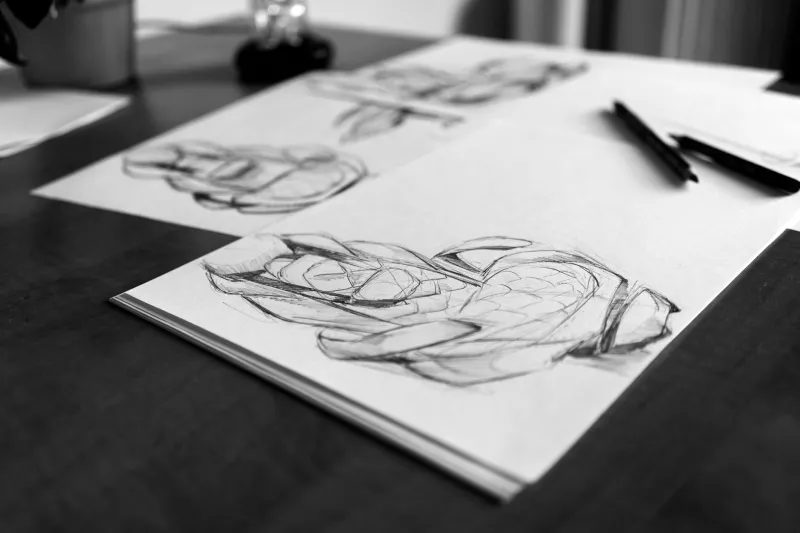
Here's a dynamic that plays out constantly in studios and on production teams across the country: a designer brings three rough concepts to a meeting. Two of them exist as sketches or loose digital thumbnails. The third has been fully rendered — textured walls, accurate light bounce, furniture with actual shadows. Guess which one gets picked.
It's not that the rendered option is necessarily the best idea. It just looks like the best idea, because it's the only one that's been given the visual vocabulary of a finished thing. The sketches, no matter how strong the underlying thinking is, are asking the client or director to do imaginative work. The render isn't asking anything. It's just presenting.
And once something is that polished, killing it feels wasteful. You've already sunk the hours. The client's already mentally moved in. The conversation shifts from "is this the right direction?" to "how do we execute this direction?" — often before anyone's actually answered the first question.
Iteration Needs Room to Breathe
Great production design — the kind that actually serves a story rather than just decorating it — almost never arrives fully formed. It comes out of a process that's genuinely exploratory: wrong turns, unexpected material combinations, a weird reference image that sparks something no one saw coming. The physical and the accidental play a huge role. A designer mocking up a set piece in cardboard might discover a proportion problem that no render would've caught, or stumble onto a texture relationship that becomes the visual signature of the whole project.
That iterative, hands-in-the-work phase is where the real decisions happen. But it requires permission to be unresolved. It requires stakeholders who can look at something rough and respond to the idea rather than the finish level. And increasingly, that permission is being quietly revoked by the expectation that every creative presentation should look like a final deliverable.
When the bar for "showing work" becomes a photorealistic preview, designers stop showing work until it's already past the point of fundamental revision. The exploration happens privately, gets edited down to a single polished direction, and arrives in the room pre-concluded. Everyone nods. Nothing surprising happens.
The Algorithm Doesn't Know What It Doesn't Know
There's another layer to this that's worth naming directly: renders are generated from parameters. A 3D environment looks exactly as good as the decisions that went into building it. The lighting is accurate to what was specified. The materials behave according to their assigned properties. It's all very logical.
But some of the best design decisions in production history came from logical failures. A set that got built slightly wrong and ended up feeling more psychologically correct than the original plan. A color choice that was a production compromise and became the defining visual of the whole film. Happy accidents, workflow collisions, the thing that happened because someone was working fast and didn't overthink it.
Digital previsualization, by its nature, doesn't accommodate accidents. It produces exactly what you asked it to produce. Which means if you don't already know what you're looking for, you might not find it — because the tool is only capable of showing you what you've already imagined.
What Early Polish Actually Signals
It's worth asking why the pressure to show finished-looking work so early has become so normalized. Part of it is client expectation — particularly in entertainment and media, where stakeholders often don't have the visual literacy to read a rough sketch as a real proposal. Part of it is competitive: studios and designers feel like they need to demonstrate capability upfront, and a stunning render does that faster than a conversation.
But part of it is also a kind of creative defensiveness. A polished render is harder to argue with. It's a way of presenting work that pre-empts criticism by looking like it doesn't need any. Which is a completely understandable instinct — and a genuinely counterproductive one, because criticism in the early stages is exactly what makes work better.
Reclaiming the Mess
None of this is an argument against digital tools. Renders are genuinely useful — at the right moment. When a direction has been chosen, when the core design decisions have been made through actual exploration, when the question shifts from what to how — that's when photorealistic previsualization earns its place in the process.
The argument is about sequencing. About protecting the early, messy, genuinely generative phase from the pressure to resolve itself prematurely. About creating space in client relationships and internal workflows where rough means in progress, not not ready.
At Studio Argila, we've been thinking a lot about what it looks like to build that space intentionally — to present work at the right level of finish for the right stage of development, and to make the case to collaborators that a sketch shown early is worth more than a render shown late. It's a harder sell in the short term. The payoff tends to show up in the final work, in the decisions that couldn't have been planned, in the directions that only emerged because no one closed the door on them too soon.
The best creative outcomes usually have a little chaos in their origin story. The goal isn't to eliminate the tools that reduce chaos — it's to make sure the chaos gets its turn first.