Stop Treating Production Designers Like Set Dressers: The Case for Getting Them in the Room Early
There's a moment that happens on a lot of productions—usually somewhere between the first production meeting and the first day of principal photography—where a production designer walks into a room, reads a script, and quietly realizes something nobody wants to hear: this doesn't work.
Maybe the story requires a character to feel trapped in their apartment, but the script describes floor-to-ceiling windows and an open floor plan. Maybe a climactic scene depends on two characters having a private conversation in a space that, as written, would realistically be surrounded by twenty extras. Maybe the visual logic of the world just doesn't hold together across the three acts.
And here's the thing—by the time the production designer is reading that script, the director has already signed off, the actors are cast, and the budget has been allocated. The window to fix any of it without serious cost? Mostly closed.
This is one of the most persistent and expensive habits in the entertainment industry, and it doesn't have to be.
What Production Designers Actually Do (Versus What People Think They Do)
Let's be honest about the misconception. In a lot of production pipelines—especially on mid-budget projects and below—production designers are treated as highly skilled executors. Someone else makes the creative decisions; the designer figures out how to make those decisions look good on screen.
That framing undersells what a great production designer actually brings to a project. These are people who think spatially, narratively, and psychologically all at once. They're reading a script and asking questions that go way beyond "what color should the walls be." They're asking: what does this space say about who lives here? Does the geography of this location support the emotional arc of this scene? Is the visual language of this world internally consistent?
That's not decoration. That's storytelling.
And when that kind of thinking gets applied in the first week of pre-production rather than the sixth, the entire project benefits.
The Reshoot Problem Nobody Wants to Talk About
Reshoots are expensive. Everyone knows this. What's less talked about is how many reshoots trace back to spatial and visual problems that could have been caught earlier—problems that a production designer, given early access to the material, would have flagged immediately.
Consider a scenario that plays out more often than studios admit: a script establishes a character's home as a reflection of their internal state—cluttered, chaotic, full of unresolved tension. The director loves this idea thematically. But no one with a design eye reviewed the practical implications before location scouting. The location that gets selected is charming but fundamentally wrong—too airy, too organized in its architecture, too difficult to dress in a way that communicates what the script needs it to communicate. The shoot happens. The footage comes back. The scene doesn't land. Now you're either living with it or going back.
A production designer in the room during early development meetings would have seen that coming. They think about space the way writers think about dialogue—as something that has to earn its place in the story.
Script Analysis as a Design Discipline
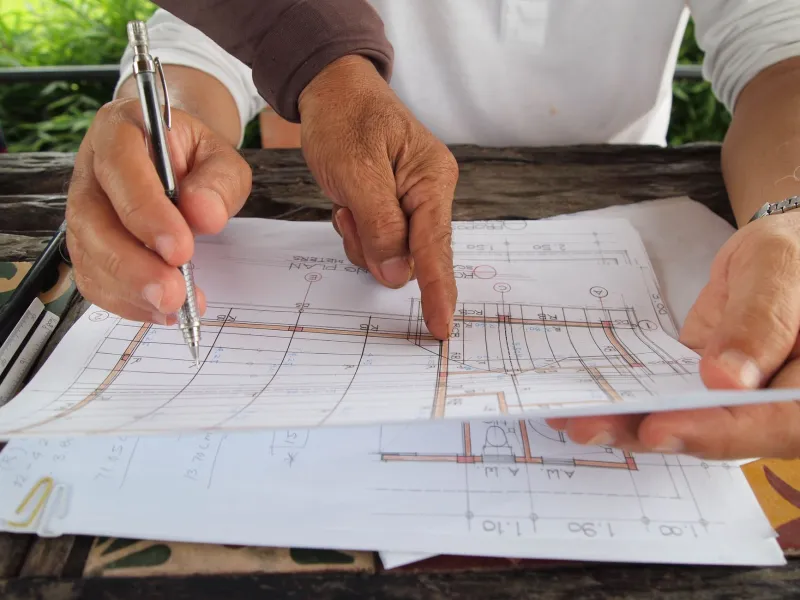
Here's what early involvement actually looks like in practice. When a production designer gets access to a script in its early drafts—ideally before it's locked—they can do something incredibly valuable: a spatial audit.
This means going through the script and mapping every location, every scene, every transition, and asking whether the visual and spatial logic holds. Are there scenes that require a layout that contradicts what was established earlier? Are there locations that serve the story emotionally but would be logistically impossible to execute on the given budget? Are there opportunities to consolidate locations in ways that save money without sacrificing narrative integrity?
This kind of analysis often surfaces plot holes, too. Not in the traditional "the timeline doesn't add up" sense, but in the visual sense. If a character is supposed to be surveilling another character from across the street, does the geography of the described space actually allow for that? If a scene's tension depends on a character not being able to leave, does the described environment physically support that?
Writers are brilliant at a lot of things, but they don't always think in three dimensions. Production designers do. That's not a criticism—it's an argument for collaboration.
The Budget Argument (Because There's Always a Budget Argument)
Some producers will push back on early designer involvement with a straightforward objection: it costs money to bring people on earlier. Why pay a production designer to sit in development meetings when you're not sure the project is even moving forward?
This is genuinely fair as a concern, but it tends to collapse under scrutiny. The cost of bringing a production designer into early strategy conversations is almost always smaller than the cost of fixing design-driven problems later. One avoided reshoot. One location that doesn't have to be rebuilt from scratch because someone caught the problem in week two instead of week ten. One set that doesn't need to be redesigned because the original concept turned out to be incompatible with the script's spatial requirements.
The math isn't complicated. Early design input is a risk-mitigation strategy as much as it's a creative one.
What This Looks Like for Smaller Studios
Not every production has the resources of a major network or streaming platform. But the principle scales down. Even on indie projects and smaller commercial productions, there's usually a version of this that works.
It might mean a single conversation between the director and the production designer early in development—before locations are scouted, before the budget is locked, before the creative direction is finalized. It might mean the production designer doing a one-day script review and delivering a short written analysis of spatial and visual concerns. The format doesn't have to be elaborate. The point is that the conversation happens before decisions are irreversible.
At Studio Argila, this is something we think about constantly—how to build creative processes that bring the right voices in at the right time, so the work that gets made is as strong as it can possibly be from the ground up.
The Bigger Shift
There's a broader cultural shift happening in how the entertainment industry thinks about production design. The best designers working today aren't waiting to be handed a script and told to make it pretty. They're positioning themselves as creative partners who can shape a project from its earliest conceptual stages—and the productions that embrace that are getting better work because of it.
The casting call isn't the beginning of a production. Neither is the first day of principal photography. The beginning is the moment someone decides what story to tell and how to tell it. Production designers belong in that conversation. The sooner studios start acting like it, the better the work is going to get.