Productive Friction: Why the Best Studios Pick Fights on Purpose
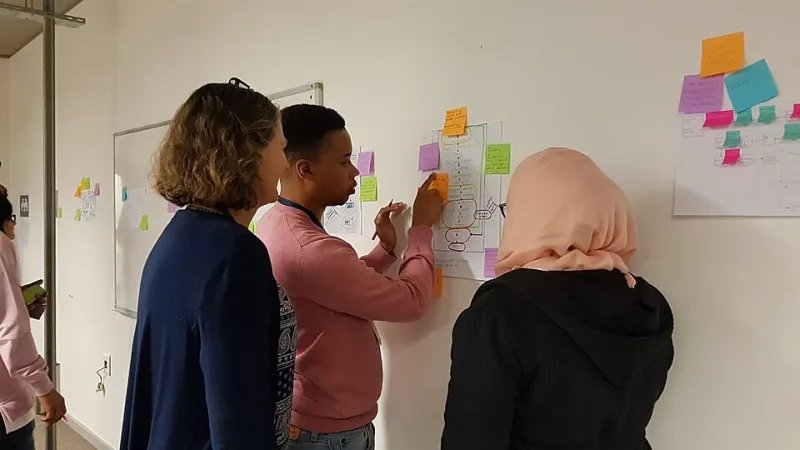
Photo: UCT MOOCs, CC BY-SA 4.0, via Wikimedia Commons
Most studios say they want honest feedback. What they've actually built is a system that makes honest feedback uncomfortable to give and easy to avoid. The approval chain is long. The stakeholders are many. The path of least resistance is a nod and a 'looks great.'
And then the work comes out looking like everything else.
There's a growing counter-movement in creative studios—particularly in media and entertainment, where the pressure to produce distinctive work is constant—that's doing something counterintuitive. They're not trying to reduce friction. They're trying to manufacture it.
What Committees Actually Do to Creative Work
Let's be honest about what design-by-committee produces. It produces work that offends no one. Work where every sharp edge has been rounded off, every provocative choice has been walked back, every interesting risk has been replaced by a proven approach. It produces beige.
The committee isn't made up of bad people with bad taste. It's made up of people who are each individually optimizing for something reasonable—risk mitigation, brand consistency, stakeholder alignment—but whose collective optimization produces outcomes none of them would actually choose on their own.
The problem isn't disagreement. Disagreement is generative. The problem is the social structure around disagreement—the hierarchy that makes dissent feel like insubordination, the approval processes that reward consensus over quality, the meeting culture that mistakes participation for progress.
Feedback Loops That Aren't Committees
So what does the alternative look like? The studios doing this well tend to share a few structural characteristics, even if they'd describe what they're doing in very different terms.
The feedback is fast and low-stakes. Instead of presenting polished work to a group for approval, work gets shared early, often, and in explicitly rough form. The psychological contract is different: this isn't a presentation, it's a provocation. React to it. Fight with it. The goal isn't sign-off—it's useful friction.
Dissent has a designated role. Some studios formally assign someone to argue against a direction. Call it a devil's advocate, a red team, whatever you want—the point is that the person pushing back isn't doing it out of personal preference or political maneuvering. It's their job for this conversation. That structural clarity makes it easier to hear and to give.
Iteration happens before the conversation, not after it. Rather than presenting one direction and defending it, teams bring multiple competing options—genuinely different options, not variations on a theme—and let the conflict between them do the work. The conversation isn't about whether the idea is good. It's about which of these good ideas is right for this.
The Studio That Runs on Disagreement
Consider the model of a mid-size production design studio working primarily on streaming content. Their creative process includes what they call a 'wreck session'—a weekly meeting where work in progress gets presented to people who had nothing to do with it, with a specific mandate to find what's wrong.
Not what could be better. What's wrong. The distinction matters. 'What could be better' invites gentle suggestions. 'What's wrong' invites honest diagnosis.
The designers presenting the work aren't allowed to explain or contextualize before the feedback starts. The work has to speak for itself. If it can't communicate its intent without a verbal guide, that's the first thing that's wrong.
Is it uncomfortable? Yes. Is the work better for it? Consistently. The studio's creative director describes it as 'the difference between showing your work to people who want it to succeed and people who are willing to tell you when it doesn't.'
Rapid Iteration as an Antidote to Paralysis
One of the most common failure modes in creative studios is the project that gets stuck in refinement. The direction is set, the work is decent, but it never quite gets to great—and the team keeps iterating, tweaking, adjusting, hoping the next pass will be the one that unlocks it.
What's usually happening is that the wrong question is being asked. The iteration is happening inside a direction that was never quite right, rather than stepping back and questioning the direction itself.
Studios that embrace productive friction tend to catch this earlier. Because the culture expects disagreement, someone is more likely to say 'I don't think this direction is working' before two weeks have been spent refining it. That's not comfortable. It is, however, much cheaper than the alternative.
Rapid iteration—the practice of moving through multiple distinct approaches quickly rather than polishing one approach slowly—only works if the culture supports the kind of honest feedback that tells you when to abandon something. Without that culture, rapid iteration just means producing more versions of the same wrong thing faster.
The Line Between Chaos and Dysfunction
It's worth being clear that not all creative conflict is productive. There's a meaningful difference between disagreement that's aimed at the work and disagreement that's aimed at the people making it. Studios that confuse the two—or that allow personal dynamics to masquerade as creative debate—end up with something worse than committee consensus: a toxic environment where the loudest voice wins.
The structural safeguards matter. Feedback needs to be about the work, not the worker. Dissent needs to be time-bounded—you can fight about a direction for an hour, but at some point a decision gets made and everyone rows in the same direction. And the person leading the project needs to have genuine authority to make the final call, even when the room is split.
Productively chaotic studios aren't leaderless. They're led by people who are comfortable being in a room full of people who disagree with them—and who know how to extract the signal from that noise.
Why This Matters More Now
The media and entertainment landscape is saturated. There are more shows, more campaigns, more branded content, more everything than anyone can actually consume. In that environment, 'good enough' is invisible. The work that gets noticed, that gets remembered, that actually earns the attention it's asking for—that work came from somewhere specific. It came from a process that was willing to be uncomfortable in service of being interesting.
Building that process takes deliberate effort. It doesn't happen by accident, and it definitely doesn't happen by adding more approval layers. It happens when studios decide that the discomfort of honest disagreement is less expensive than the cost of playing it safe.